f you're running a small metal fabrication shop, you already know the drill. Sheets come in, they hit the floor, and before long you've got pallets stacked three deep eating up the aisle space you need to actually run the place. It looks like a storage problem. It's actually a production problem.
The good news: you don't need more square footage. You need a smarter approach to storing sheet metal—one that gets material off the floor, keeps it organized, and makes retrieval fast enough that your team isn't burning 20 minutes doing The Shuffle before every cut.
Wooden pallets are what shops reach for when there's no better option. They're cheap, they're available, and they work—until they don't. Here's what floor-stacking on pallets is actually costing you:
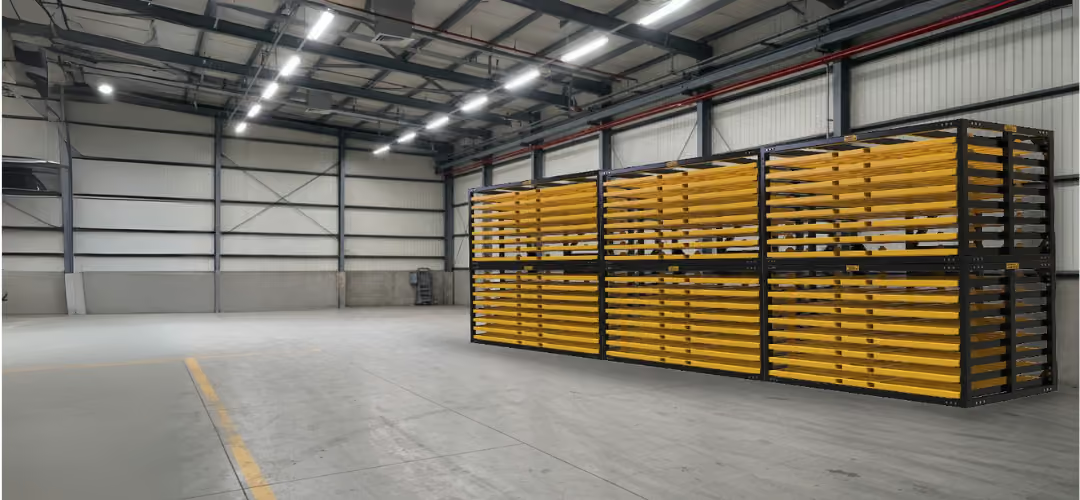
The most impactful change a small shop can make to its sheet metal storage isn't buying a bigger building—it's using the vertical space it already has. Most fabrication shops have 14 to 20 feet of ceiling clearance they're doing nothing with. That's Invisible Square Footage waiting to be put to work.
A proper sheet metal storage rack pulls your material up off the floor and organizes it by gauge, size, or job—whatever system works for your operation. Instead of digging, your team walks up and pulls exactly what they need. Retrieval that used to take 15 minutes takes 90 seconds.
Not every shop is the same, and not every rack is the right fit. Here's a quick breakdown of what works for different operations:
If you're loading and unloading with a forklift, the Standard Sheet Metal Storage Rack is your workhorse. It handles 4x8, 5x10, and 6x12 sheets with a 5,000 lb capacity per shelf, and it fits the workflow most small shops already have. Need crane or drawer access in addition to forklift loading? The Combo Sheet Metal Storage Rack gives you both in one system.
For shops equipped with an overhead crane or vacuum lifter, the Ridgeline Vertical Sheet Metal Rack stores sheets upright with a 2,000 lb capacity per bay. Standing sheets vertically eliminates the tip risk inherent in horizontal stacks and makes single-sheet retrieval fast and clean—no digging, no shuffling, no Laser-Ready Sheets coming out scratched.
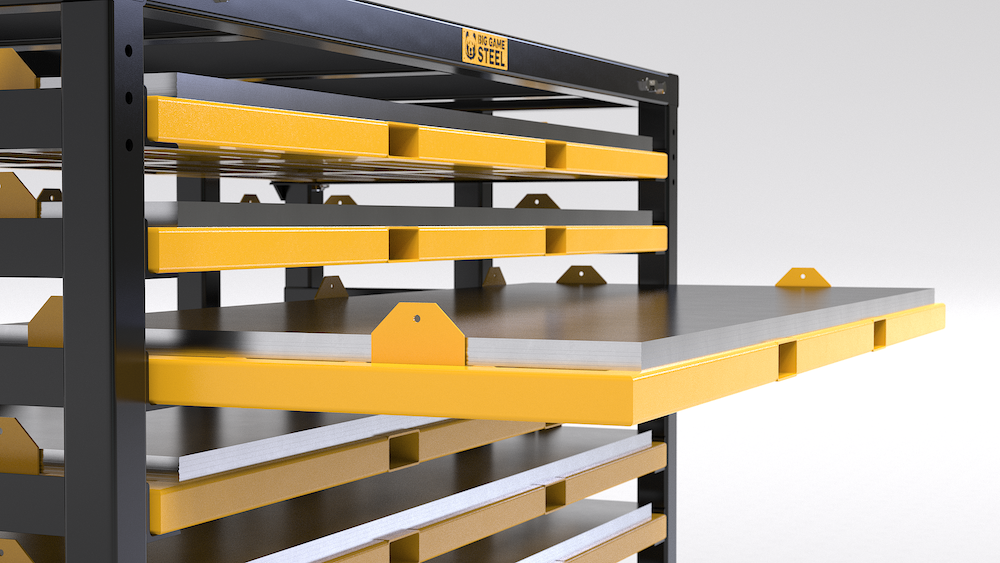
When speed of access is the priority, the Roll-Out Sheet Metal Rack delivers 100% drawer extension so your team can access any sheet without moving anything else. At 5,000 lbs of capacity, it handles heavy plate while keeping your floor clear and your workflow moving.
Getting off pallets is step one. Here's how to make the transition stick:
For shops running precision laser cutting, material condition isn't just a quality concern—it's a profitability concern. A scratched sheet, an oxidized surface, or a warped edge can mean a rejected part and a recut. Industrial steel racks eliminate the surface contact damage that happens when sheets are stacked flat and dragged against each other during retrieval.
Unlike wooden pallets, steel cassette systems don't wick moisture. Your Laser-Ready Sheets stay clean, flat, and in spec from the moment they arrive until the moment they hit the cutting table.
The safest approach is to get sheet metal off the floor entirely and into a purpose-built storage rack. Vertical racks eliminate tip risk, reduce forklift traffic, and keep aisles clear. Horizontal racks with organized shelving prevent the material movement hazards that come with floor-stacking and pallet shuffling.
Yes. Big Game Steel's Standard and Combo racks are engineered to handle 4x8, 5x10, and 6x12 sheets within the same system. The key is organizing bays by gauge or material type so retrieval stays fast and your team always knows where to look.
Vertical storage is the most space-efficient option for tight layouts because it trades floor footprint for height. A Ridgeline Vertical Rack occupies a fraction of the floor space of a horizontal pallet setup while holding the same amount of material. Positioning racks along walls or perimeter zones also preserves the center-floor working space your machines require.
Significantly. Sheets destined for precision laser cutting need to arrive at the machine free of scratches, oxidation, and edge deformation. Steel rack systems prevent the surface-to-surface contact damage that floor stacking causes. They also eliminate moisture exposure from wooden pallets, which is a common source of surface oxidation on steel sheet stock.
If your shop is still running on pallets, you're not dealing with a storage problem—you're dealing with a production bottleneck. The right sheet metal storage system pays for itself fast: in reduced retrieval time, in material you're not scrapping, and in floor space you suddenly have back.
Big Game Steel builds heavy-duty storage systems engineered specifically for metal fabrication environments. Contact us to talk through the right solution for your shop size, material mix, and loading method. We'll help you stop stacking and start producing.