alk through most fabrication shops and you'll find the same problem: material is everywhere, but organized is not the word anyone would use to describe it. Sheets are stacked on pallets by delivery order rather than gauge. Remnants are piled in corners. Partial bundles get buried behind full ones. And at some point every shift, someone spends 10 to 15 minutes just finding what they need.
This is a management problem masquerading as a space problem. The fix isn't more square footage. It's a storage system that organizes inventory by the logic your production actually runs on.
It usually starts reasonably enough. Material comes in, it goes on a pallet, the pallet goes somewhere that isn't in the way. But over time the system erodes:
The result is Floor Debt: dead square footage generating no production value, combined with retrieval delays that compound across every shift. Most shops accept this as the cost of doing business. It isn't. It's the cost of not having a system.
Effective fabrication shop inventory organization comes down to one rule: every material type has a dedicated, labeled location, and nothing goes anywhere else.
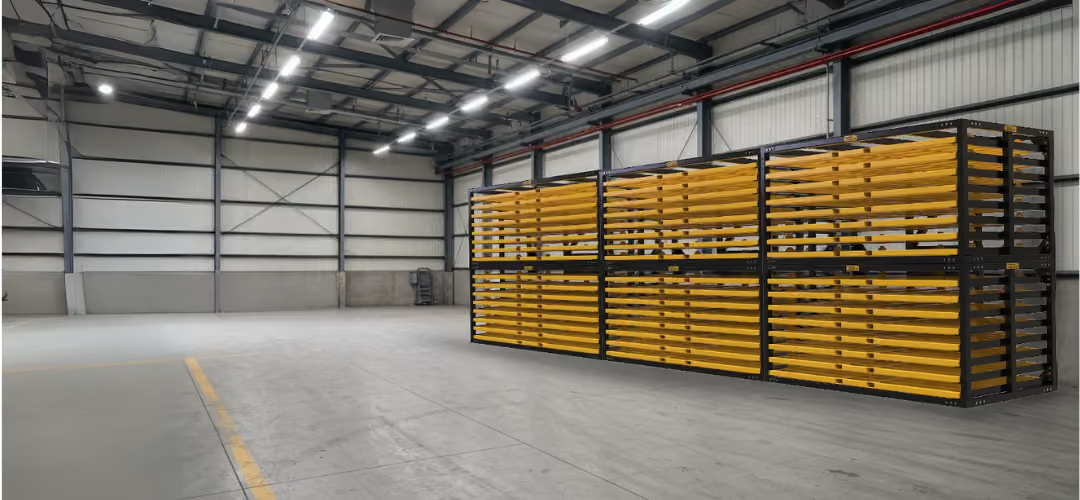
Steel storage racks make this rule enforceable. Without a rack, the floor is just space, and space fills up with whatever is convenient. With a rack, every bay or shelf slot is a defined address. 14-gauge cold rolled lives in bay 1. 10-gauge in bay 2. 3/16" plate in bay 3. The address doesn't change. Material either goes to its address or it doesn't go in the rack.
This shift from floor-based to rack-based storage is the single most impactful operational change most fabrication shops can make without touching their machines or their headcount.
The right organization system depends on how your shop actually runs. Here are the most effective frameworks:
The most common and effective approach for general fabrication. Each bay holds one gauge, and only that gauge. Your team develops automatic muscle memory: need 16-gauge, go to bay 4. No searching, no asking, no guessing. This also prevents mixed-gauge bays from creating weight distribution problems or loading confusion.
Shops running multiple alloys alongside carbon steel benefit from organizing by material type first, gauge second. Stainless in one section, aluminum in another, carbon steel in a third. This also prevents cross-contamination issues that create quality problems downstream, particularly on stainless work where carbon steel contact causes surface issues.
High-mix shops running dedicated job lots sometimes benefit from staging material by active job rather than by gauge. A designated bay holds all the material for a specific job currently in production. When the job ships, the bay clears. This approach works best alongside a separate general stock area organized by gauge.
Position your highest-volume gauges closest to your primary machine. If 14-gauge cold rolled accounts for 40% of your cuts, it should be the first bay your operator reaches without taking more than a few steps from the cutting table. Low-turnover material can sit at the perimeter. This isn't complexity; it's physics applied to workflow.
The organizing framework only works if the rack itself supports the retrieval method your team uses. Here's how to match them:
The Standard Sheet Metal Storage Rack is the baseline for forklift-loaded operations. At 5,000 lb capacity per shelf with compatibility for 4x8, 5x10, and 6x12 sheets, it handles the full range of stock sizes most shops run. Dedicate each shelf to a specific gauge and label clearly. The Combo Sheet Metal Storage Rack adds crane and drawer access to the same system for shops that need more retrieval flexibility without splitting into two separate racks.
When your team pulls individual sheets frequently throughout the shift, the Roll-Out Sheet Metal Rack gives every slot full drawer extension at 5,000 lb capacity. Each drawer is independently accessible without disturbing adjacent material. For shops where The Shuffle is a daily occurrence, roll-out storage eliminates it entirely. Every gauge gets its own drawer with its own label; retrieval becomes a two-step process: open the right drawer, pull the sheet.
Shops with ceiling height to spare and overhead handling equipment can maximize Invisible Square Footage with the Ridgeline Vertical Sheet Metal Rack. Sheets stand upright in individual bays at 2,000 lb per bay, organized by gauge or material type. The compact floor footprint frees up the center-floor working space your machines require while keeping every sheet immediately accessible to the crane.
A rack without labels is just a rack. The labeling system is what turns a storage system into an inventory system. A few principles that work:
Organized inventory doesn't just reduce retrieval time. The downstream effects compound:
The most effective approach is to assign every material type a dedicated, labeled bay in a purpose-built steel storage rack and enforce the rule that material always returns to its address. Organizing by gauge works well for most shops. High-mix operations may benefit from a secondary layer of organization by material type or active job. The key is making the system visible and consistent.
Steel storage racks replace open floor storage with a defined address system. Each bay holds a specific material type, making inventory visible at a glance. This eliminates search time, prevents mixed-gauge storage, supports accurate stock level monitoring, and creates a consistent system that any operator can navigate without tribal knowledge.
Label each bay or shelf slot with gauge, material type, and sheet size using paint markers or adhesive labels that can withstand a shop environment. Post a bay map near the rack entrance. Mark each bay with a minimum stock level indicator so replenishment triggers are visible rather than tracked informally.
High-mix shops benefit most from systems that allow individual sheet access without disturbing adjacent material. A Roll-Out Sheet Metal Rack with 100% drawer extension gives every gauge its own independently accessible drawer. For shops also managing large bundles by forklift, a Combo Rack that combines horizontal shelving with drawer access handles both needs in a single system.
The most practical approach for most fabrication shops is visual inventory management: organized racks with labeled bays and physical reorder indicators. When every gauge has a dedicated bay and a marked minimum level, inventory status is visible on the floor without needing software. For higher-volume operations, this physical system integrates naturally with ERP or inventory management software by giving every SKU a fixed, identifiable location.
Disorganized inventory is a production problem, not just an aesthetics problem. The right steel storage rack system turns floor chaos into a defined, navigable inventory system that every operator on every shift can use without guesswork.
Big Game Steel builds heavy-duty steel storage racks engineered for the demands of production fabrication environments. Contact us or call 847-380-0860 to talk through the right configuration for your shop.