laser cutter is only as productive as the material flow feeding it. You can have the fastest fiber laser on the market, but if your operators are spending 10 minutes per job hunting down the right gauge, repositioning pallets, or waiting on a forklift to clear a path, that machine isn't running at capacity. It's running at the capacity of your storage system.
This is a problem that a well-configured steel sheet rack solves directly. Not by making the laser faster. By eliminating the dead time between cuts.
Most laser cutting shops track machine uptime. Fewer track the time between jobs: the interval between the last sheet leaving the table and the next one landing on it. That interval is where the real productivity losses live.
In a shop running floor-stacked pallets, a typical sheet changeover looks like this: an operator identifies the next job, locates the correct gauge, realizes it's buried under two other pallets, calls for the forklift, waits, moves the pallets, extracts the sheet, moves the pallets back, and loads the table. That sequence can easily eat 15 minutes on a job that takes 8 minutes to cut.
This is The Shuffle, and it's not a minor inefficiency. It's a structural one that compounds across every shift, every day.
A purpose-built steel sheet rack addresses the flow problem at its source by changing how material is staged, accessed, and fed to the machine.
When every bay in a rack holds a defined material type (say, 14-gauge cold rolled in bay 1, 10-gauge in bay 2, 3/16" plate in bay 3), operators don't search. They go directly to the right bay, pull the sheet, and load. The cognitive work of finding material is eliminated. So is the physical work of digging for it.
Horizontal floor stacks require moving multiple sheets or pallets to reach a specific piece. A rack system, whether drawer-style or vertical bay, gives direct access to each sheet independently. Pull one, leave the rest undisturbed. No forklift required between cuts.
A well-designed rack fits tight to the work cell it feeds. Instead of a 40-foot trip across the shop floor, your operator takes 10 steps to the rack and 10 steps back. Material travel time drops to near zero. On a high-mix shop running 15 to 25 jobs per shift, that's a meaningful time recovery.
Laser-Ready Sheets need to arrive at the cutting table flat, clean, and scratch-free. A rack that supports sheets properly across their full width prevents the bowing that develops in floor-stacked material. Steel cassettes eliminate the moisture exposure from wooden pallets that causes surface oxidation and inconsistent cut performance. Every sheet that arrives in spec is a recut you didn't have to do.
The right rack configuration depends on how your shop loads material and what your retrieval pattern looks like.
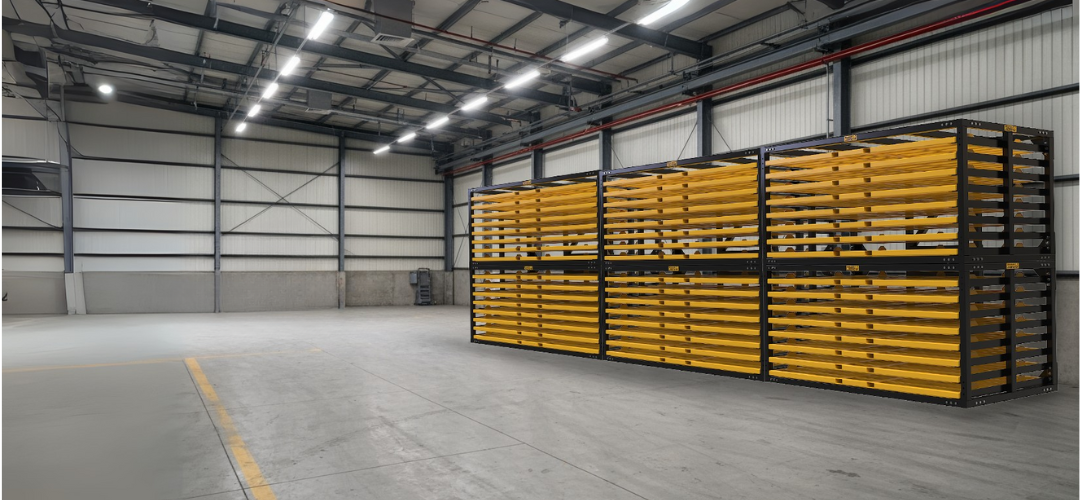
Shops running a wide variety of gauges and pulling individual sheets frequently need a system that makes every slot independently accessible. The Roll-Out Sheet Metal Rack delivers 100% drawer extension at 5,000 lb capacity. Every sheet is fully accessible without moving anything else. Changeover time drops to seconds.
For shops loading and staging with overhead equipment, the Ridgeline Vertical Sheet Metal Rack stores sheets upright in individual bays at 2,000 lb per bay. Vertical storage eliminates surface-to-surface contact entirely and allows a vacuum lifter to pull a single sheet cleanly without disturbing adjacent material. The footprint is minimal, which lets you position the rack directly adjacent to the cutting table.
The Combo Sheet Metal Storage Rack handles forklift loading with 5,000 lb shelves while also supporting crane and drawer access for individual sheet retrieval. It's the right call when you receive full bundles by forklift but need single-sheet pull capability during production runs.
The math on material flow improvement is straightforward. Consider a shop running two shifts, averaging 20 sheet changeovers per shift, with an average of 10 minutes lost per changeover to The Shuffle:
A rack system that reduces changeover time from 10 minutes to 90 seconds recovers the majority of that lost capacity without adding a single machine or operator. In high-volume shops, that recovered time translates directly to additional jobs completed per shift.
Advanced shops don't just retrieve material faster. They stage it proactively. With an organized sheet metal storage system adjacent to the cutting table, operators can pull and position the next job's material while the current nest is still running. By the time the laser finishes, the next sheet is ready to load. Machine downtime between jobs drops to the time it takes to swap the sheet.
This kind of parallel workflow isn't possible when material is buried in a pallet stack across the shop. It's only possible when every sheet is organized, labeled, and reachable within arm's length of the work cell.
By eliminating the retrieval time between cuts. When material is organized by gauge in accessible rack bays adjacent to the cutting table, changeover time drops from 10-15 minutes to under 2 minutes per job. Across a full shift, that time recovery translates directly to additional cutting capacity without adding equipment or headcount.
It depends on your loading equipment. Shops with vacuum lifters or overhead cranes benefit most from vertical storage or roll-out drawers that allow single-sheet access without forklift involvement. Shops loading with forklifts should consider a Combo Rack that supports both bundle loading and single-sheet retrieval during production runs.
Material should be organized by gauge and size in clearly labeled bays, positioned as close to the cutting table as your floor layout allows. The goal is to eliminate forklift involvement between cuts and allow operators to stage the next job while the current one is running. A rack system adjacent to the laser work cell makes this possible.
Yes. Sheets stored improperly develop surface oxidation, scratches, and bow that affect cut quality and consistency. A steel rack system that supports sheets across their full width and keeps them off wooden pallets protects material condition from receipt through cutting. Flat, clean, oxide-free sheets cut more consistently and reduce scrap rates.
As close as your floor layout and loading method allow. Ideally, material storage sits within one or two steps of the loading zone so operators can retrieve and stage sheets without crossing the shop floor. Vertical and roll-out rack systems have compact footprints that make tight placement practical even in smaller shops.
Material flow is the hidden variable in laser cutting productivity. Get the storage system right and your machine runs closer to its actual capacity. Get it wrong and you're paying for a laser that spends half its time waiting.
Big Game Steel builds heavy-duty steel sheet racks engineered for the demands of production laser cutting environments. Contact us or call 847-380-0860 to talk through the right configuration for your shop.