hick plate steel is an entirely different animal from thin-gauge sheet stock. A single 6x12 sheet of 1/4" plate weighs close to 490 lbs. Stack ten of those on a shelf not engineered for the load and you have a deflection problem, a tip-over risk, and a serious liability. Stack them on the floor on wooden pallets and you compound every one of those problems while adding moisture exposure, retrieval hazards, and OSHA compliance issues on top.
Heavy duty sheet metal storage racks purpose-built for thick plate aren't a luxury for shops running 3/16" and heavier. They're the minimum viable solution for keeping material organized, accessible, and safe in an environment where the loads involved can injure people and destroy equipment if the storage system isn't up to the job.
The weight difference between thin-gauge and thick plate isn't incremental. It's exponential relative to what most shops assume their storage can handle. Here's what that weight means in practice:
The term "heavy duty" gets applied loosely in the industrial storage market. For thick plate applications specifically, it means something precise. Here's what to look for:
5,000 lbs per shelf is the practical baseline for thick plate storage. That rating needs to apply to your actual sheet sizes, not just a theoretical distributed load. A 6x12 sheet spanning across support points generates different bending forces than a fully supported 4x8 sheet. Confirm the capacity spec is validated for the largest sheet format you run.
Purpose-built sheet metal storage racks use welded construction throughout, not bolted-together modular systems assembled from light-gauge components. Welded frames handle the dynamic loads of forklift placement and crane picks without fastener fatigue. In a thick plate application where loading events are heavier and less frequent, weld integrity is the structural backbone that keeps the system safe over time.
Large-format thick plate (5x10 and 6x12 sheets) requires shelf support across the full sheet width to prevent sagging. A rack that only supports sheets at their edges leaves the center span unsupported, allowing bow to develop under load. That bow affects material flatness and creates a quality problem before the sheet ever reaches the machine.
Thick plate stored on wooden pallets sits in direct contact with moisture-absorbing material. Steel cassettes eliminate this contact point. For plate that may sit in storage for weeks between jobs, the difference between steel and wood contact surfaces is the difference between material that arrives at the machine in spec and material showing surface oxidation that contaminates welds and disrupts laser cut performance.
A rack loaded with thick plate imposes significant concentrated loads on the floor beneath it. The rack should be specified with floor anchor requirements and the installation should confirm the concrete can support the load. A system that tips or shifts under a heavy bundle is a catastrophic failure, not a maintenance issue.
The safety stakes for thick plate storage are higher than for thin-gauge material for one simple reason: the consequences of a failure are proportional to the weight involved.
A heavy duty rack that keeps thick plate in stable, defined positions eliminates the first two hazards entirely. Combined with crane or forklift loading that removes manual handling from the equation, it addresses the third.
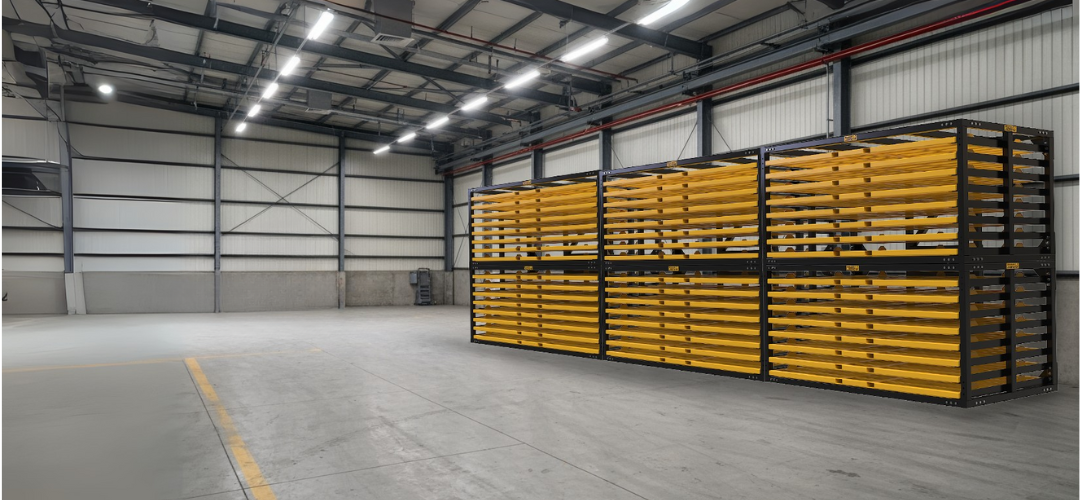
Big Game Steel's sheet metal storage rack systems are engineered from the ground up for production fabrication environments. Here's how each system applies to thick plate applications:
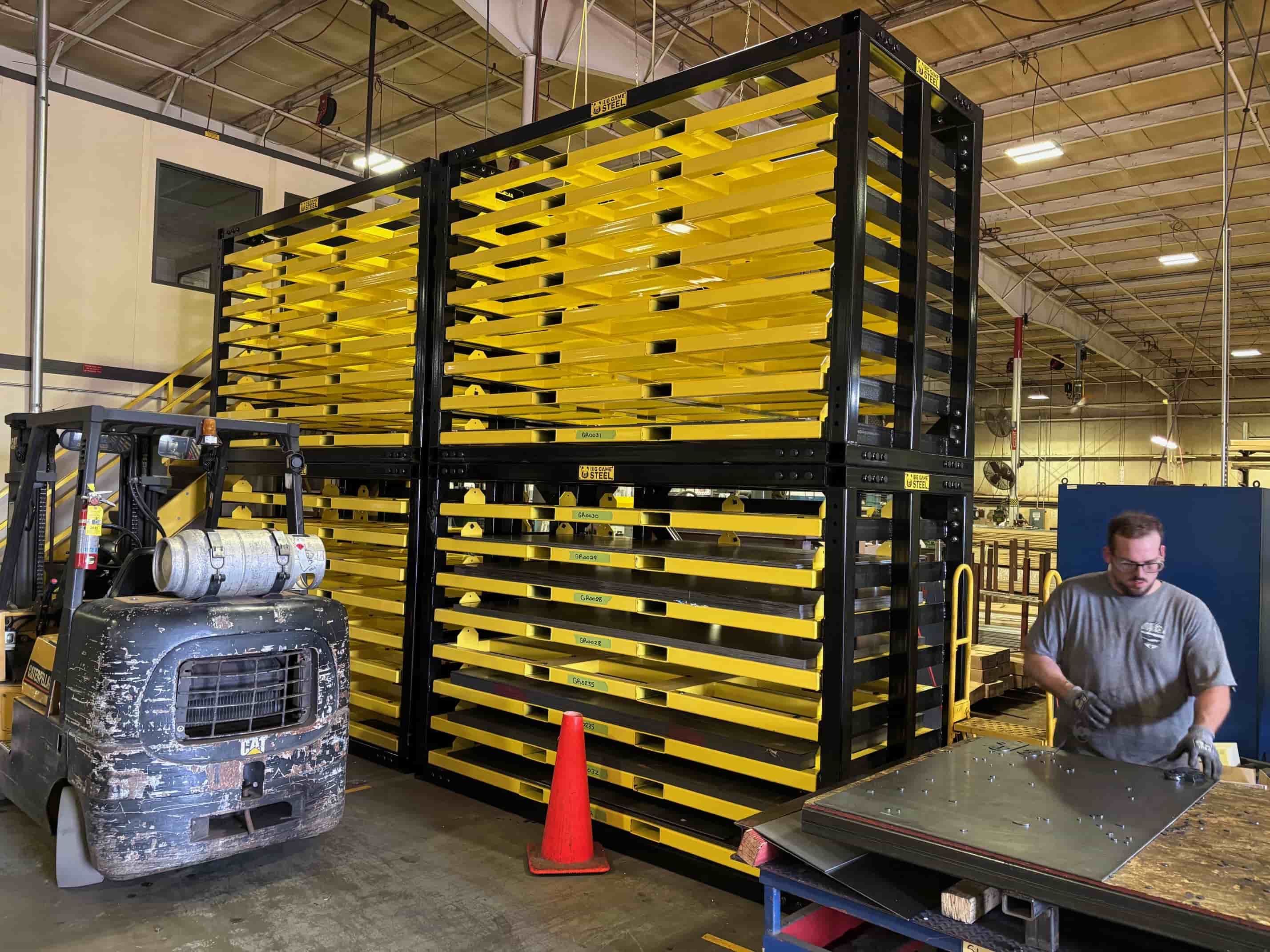
The Standard Rack handles forklift loading at 5,000 lbs per shelf, with compatibility for 4x8, 5x10, and 6x12 sheet sizes. For thick plate shops running forklift loading as their primary material handling method, this is the workhorse: rated for the load, built for the sheet sizes, and straightforward to integrate into an existing workflow.
The Combo Rack combines forklift loading with crane and drawer access in a single system. For thick plate operations that receive full bundles by forklift but need to pull individual sheets by crane during production, the Combo eliminates the need for two separate rack installations. One system handles both the receiving and the retrieval.
The Roll-Out Rack delivers 100% drawer extension at 5,000 lb capacity per drawer. For crane or vacuum lifter equipped shops pulling thick plate frequently, full extension means the overhead equipment can access any sheet in the drawer without repositioning the rack or overreaching. For heavy plate where each retrieval involves hundreds of pounds, clean and complete access is a safety requirement, not a convenience.
Most fabrication shops don't run exclusively thick plate. They run a range of gauges, and the storage system needs to handle that mix without creating load distribution problems or organizational confusion.
5,000 lbs per shelf is the practical minimum for shops regularly handling 10-gauge through 1/4" plate and heavier. Equally important is confirming that the rated capacity applies to your actual sheet sizes. A shelf rated for 5,000 lbs on 4x8 sheets behaves differently under a full bundle of 6x12 plate spanning a wider unsupported distance.
Purpose-built heavy duty sheet metal storage racks with documented 5,000 lb per shelf ratings are safe for thick plate when properly installed and anchored. Generic warehouse racking, pallet rack systems, or light-duty shelving are not appropriate for thick plate storage. The load concentrations, sheet spans, and dynamic loading from forklift placement exceed what those systems are designed to handle.
OSHA 29 CFR 1910.176 requires that material be stored in a stable, secure manner that prevents collapse or tipping, and that storage areas be kept clear of hazardous accumulations. For thick plate specifically, this means using a rack system rated for the load, anchored to the floor per manufacturer specifications, and positioned to maintain required aisle and egress clearances.
For forklift-loaded operations, a Standard or Combo Sheet Metal Storage Rack rated at 5,000 lbs per shelf with welded structural steel construction handles thick plate reliably. For crane or vacuum lifter equipped shops pulling individual sheets, a Roll-Out Rack with 100% drawer extension gives safe, clean access to heavy plate without manual repositioning.
Yes, but thick plate and thin-gauge material should be kept in dedicated, separate bays rather than mixed together. Mixing material in the same bay creates load distribution problems, increases the risk of inadvertently overloading a shelf, and creates organizational confusion during retrieval. A clearly labeled, bay-per-gauge system keeps the storage organized and the loads manageable.
Thick plate storage isn't a situation where a standard shelving solution scales up. The loads involved demand a system engineered specifically for the weight, the sheet sizes, and the loading method your shop uses every day.
Big Game Steel builds heavy duty sheet metal storage racks designed for the demands of production fabrication, including thick plate applications. Contact us or call 847-380-0860 to talk through the right configuration for your material mix and load requirements.